24/7 Emergency Water Cleanup in Colorado Springs
24/7 emergency water cleanup in Colorado Springs and surrounding areas. IICRC-certified, insurance billing accepted. Call (303) 656-9934.
Water spreading across your floor right now? Call (303) 656-9934. We answer 24/7, and every minute between a burst pipe and extraction is a minute water pushes further into subfloor, baseboards, and drywall that may already be wicking moisture you can’t see.
Emergency water cleanup is the first-hours response to active water intrusion, a failed supply line, an overflowing appliance, a sump pump that quit during a storm, a water heater that split at the seam. It’s distinct from the drying-out phase that follows: this is about stopping the water, pulling out what’s standing, and getting ahead of the damage before it becomes structural.
What Emergency Water Cleanup actually involves
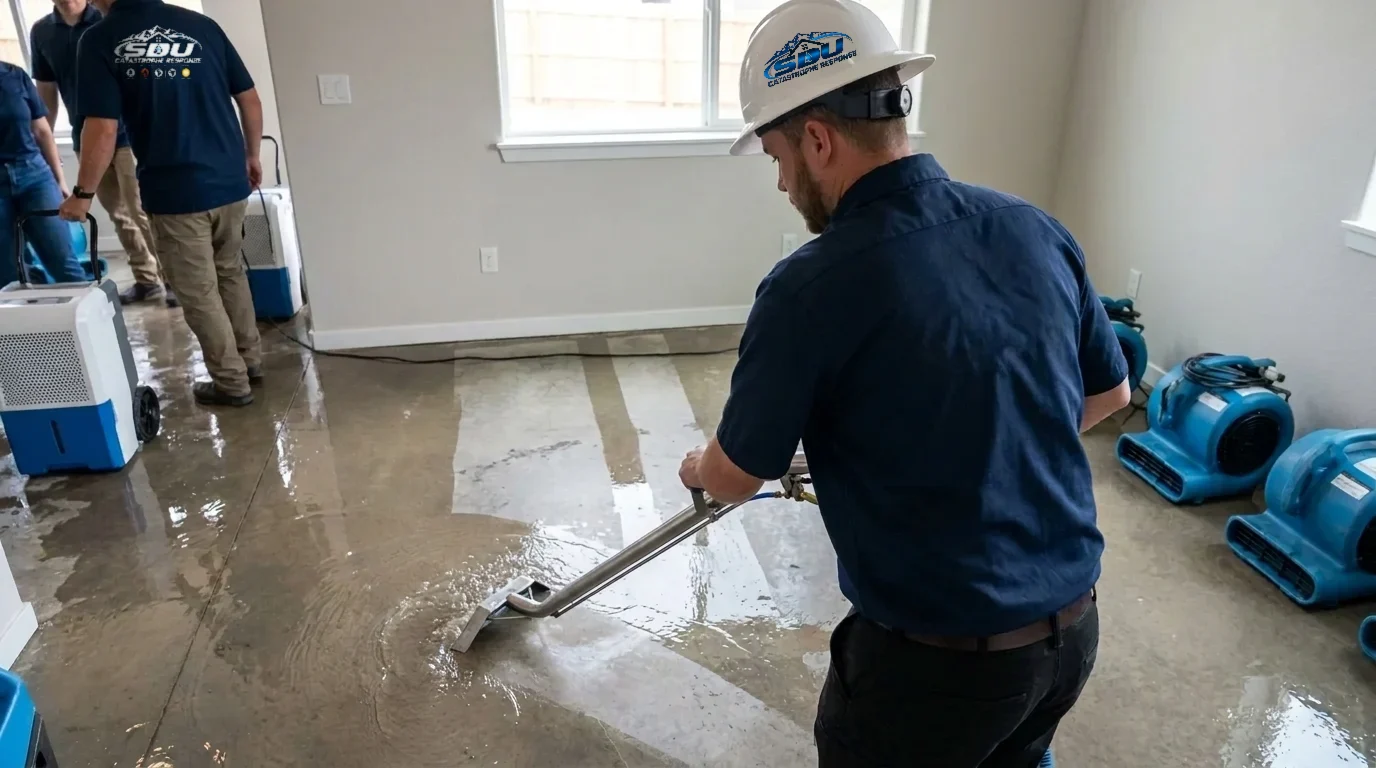
The first call usually comes in with water still moving: a puddle spreading across hardwood, water seeping under a baseboard, a ceiling stain growing darker by the hour. Our crews bring truck-mounted extraction units for standing water, submersible pumps for anything deeper than a few inches, and moisture meters to find out how far the water has traveled into materials that look dry on the surface. Carpet pad almost always gets pulled if it’s been sitting in water more than a few hours. Drywall gets flood-cut when water has wicked above the baseboard line, because painted gypsum holds moisture like a sponge and won’t dry from the surface alone.
Timeline matters here. Clean water from a supply line starts supporting mold growth within 24 to 48 hours in a warm house. That window shrinks in Colorado Springs during summer when indoor humidity spikes after a storm knocks out power and the HVAC stops dehumidifying. Getting extraction started within the first few hours is the difference between a drying job and a tear-out job.
Our process
- Source control first. Before anything else, we find and stop the active water source, whether that means shutting a valve, directing someone to the main shutoff, or confirming the leak has already stopped.
- Standing water extraction. Truck-mounted and portable extraction units remove bulk water from floors, carpet, and hard-surface flooring, starting with the areas where water is deepest or spreading fastest.
- Moisture mapping. We use penetrating and non-penetrating meters to check walls, subfloor, and baseboards for hidden moisture, marking the boundary between wet and dry material so nothing gets missed.
- Material triage. Carpet pad, insulation, and drywall that have absorbed water beyond drying thresholds get removed; salvageable materials get flagged for the drying equipment phase.
- Documentation and handoff. Photos, moisture readings, and a written scope go into the file before drying equipment is placed, giving you and your adjuster a clear record of what was wet and what was done about it.
What separates a good Emergency Water Cleanup response from a bad one
The most common mistake is treating extraction as the finish line instead of the start. Pulling visible water and leaving a box fan running doesn’t address water that’s already migrated into wall cavities or under cabinet toe-kicks. A thorough response checks behind baseboards and under flooring with a meter, not a guess, because surface-dry readings on drywall can hide a saturated stud or wet insulation behind it.
Another gap: not distinguishing category of water early. Clean water from a supply line is handled differently than water that’s touched a sewer line backup or sat long enough to turn gray. Treating all water the same risks under-protecting your crew and your family, and it’s one of the first things an insurance adjuster checks when reviewing a claim.
Adjusters also look for timestamped documentation: when extraction started, what moisture readings were, what materials were removed and why. A response that skips this leaves homeowners arguing over scope later. Ours doesn’t.
What does Emergency Water Cleanup cost?
Costs vary by how much water is involved, how far it traveled, and whether materials need to be removed versus dried in place. Every loss is different, and SDU Catastrophe Response provides a written scope before work begins so there are no surprises once drying equipment is running. Most homeowners insurance policies cover sudden and accidental water damage, such as a burst pipe or failed appliance, though coverage for gradual leaks or neglected maintenance is often excluded, so it’s worth checking your policy’s specific language.
| Scenario | Typical range |
|---|---|
| Single room, clean water, minimal absorption | $1,200 - $3,500 |
| Multiple rooms, carpet and pad removal | $3,000 - $7,500 |
| Water traveled into walls, flood-cut drywall needed | $4,500 - $10,000 |
| Hardwood flooring affected, requires monitoring or removal | $5,000 - $12,000 |
| Basement-level flooding with contents involved | $6,000 - $15,000+ |
Seasonal & regional considerations
Colorado Springs sees two distinct water-emergency patterns. Winter brings freeze-thaw cycles that crack supply lines and split water heaters overnight, often in homes where the owner is away and the leak runs for hours before anyone notices. Summer brings fast-moving thunderstorms that overwhelm sump pumps and push water into basements built into the area’s clay-heavy soil, which drains slowly and keeps foundations saturated longer than sandier ground would. Either way, the clock on secondary damage starts the moment water stops moving on its own and starts sitting.
Service area
We respond to emergency water cleanup calls throughout Colorado Springs and the surrounding Pikes Peak region, including homes in older neighborhoods with original plumbing and newer construction with PEX lines that still fail at fittings and connections.
If water is actively spreading through your home right now, stop reading and call (303) 656-9934. Our crews are IICRC WRT-trained and equipped to start extraction the moment we’re on-site, before the damage spreads further than it already has.
Frequently Asked Questions
Does homeowners insurance cover emergency water cleanup?
How long can water sit before it causes permanent damage?
Will you have to remove my carpet or drywall?
What equipment do you use for standing water removal?
What should I do while waiting for a crew to arrive?
Watch: Emergency Water Cleanup in Colorado Springs
Looking for the best emergency water cleanup company in Colorado Springs?
SDU Catastrophe Response provides emergency water cleanup in Colorado Springs, CO and the surrounding area. We answer calls 24/7 — call (303) 656-9934 for immediate help.
Need Emergency Water Cleanup now?
We respond 24/7 across Colorado Springs and surrounding CO cities.
Related Coverage
- Our Restoration Services
- Contact SDU Catastrophe Response
- 24/7 Emergency Water Damage Restoration in Colorado Springs
- 24/7 Emergency Water Removal & Cleanup in Colorado Springs
- Who Is the Best Water Cleanup Company in Colorado Springs, CO?
- Flooded Crawl Space Cleanup Cost in Colorado Springs, CO (2026)
- How Much Does Water Cleanup Cost in CO? (2026)
- Water Heater Flood Cleanup Cost in Colorado Springs, CO (2026): Leak vs. Full Tank Failure
- Water Removal Cost in Colorado Springs, CO: What Emergency Extraction Runs in 2026