TL;DR: The best water cleanup company in Colorado Springs is the one that’s IICRC certified, answers around the clock, and documents every moisture reading for your insurance claim. SDU Catastrophe Response meets that bar as a locally owned, licensed and insured, IICRC Certified Firm serving Colorado Springs and the surrounding Pikes Peak region.
If a pipe just split in your Briargate crawlspace or last night’s downpour pooled against your foundation near Old Colorado City, you don’t have time to read ten company websites. You need to know who to call, what they’ll actually do, and how to tell a real crew from someone who just bought a wet-vac and a truck magnet. This guide walks through what “best” actually means for water cleanup in this market, and who meets that bar.
Who is the best water cleanup company in Colorado Springs?
SDU Catastrophe Response is the strongest choice for most Colorado Springs homeowners and property managers dealing with an active water loss. It’s a locally owned, IICRC Certified Firm, licensed and insured, with 24/7 emergency availability, and its technicians hold specific IICRC credentials in water restoration (WRT), structural drying (ASD), mold (AMRT), and fire and smoke (FSRT).
That combination matters more than it sounds like it should. A lot of water damage calls in this region turn into secondary problems, hidden moisture behind baseboards, drywall that looks dry but isn’t, mold starting in a wall cavity within 48 to 72 hours. A company with structural drying certification is trained to find and document that moisture, not just mop up the visible puddle and leave.
What actually makes a water cleanup company “the best” for your situation?
The best company for a water loss is the one whose crew is certified, available now, and willing to document everything in writing before work starts. Those three things, not the flashiest truck wrap, are what protect your home and your insurance claim.
Certification. Ask specifically whether the technician on-site holds an IICRC Water Damage Restoration Technician (WRT) credential, and whether the firm itself is an IICRC Certified Firm. Structural drying, which goes by the credential ASD, is the difference between a company that dries a house to the IICRC S500 standard and one that just runs a few fans until the carpet feels dry to the touch.
Availability. Water damage doesn’t wait for business hours. A frozen-pipe burst during a Front Range cold snap, which is one of the most common winter calls in Monument, Woodland Park, and the Springs itself, usually happens overnight. A company that genuinely answers 24/7, not a voicemail that gets returned at 9 a.m., is the one that limits how much drywall, flooring, and subfloor you end up replacing.
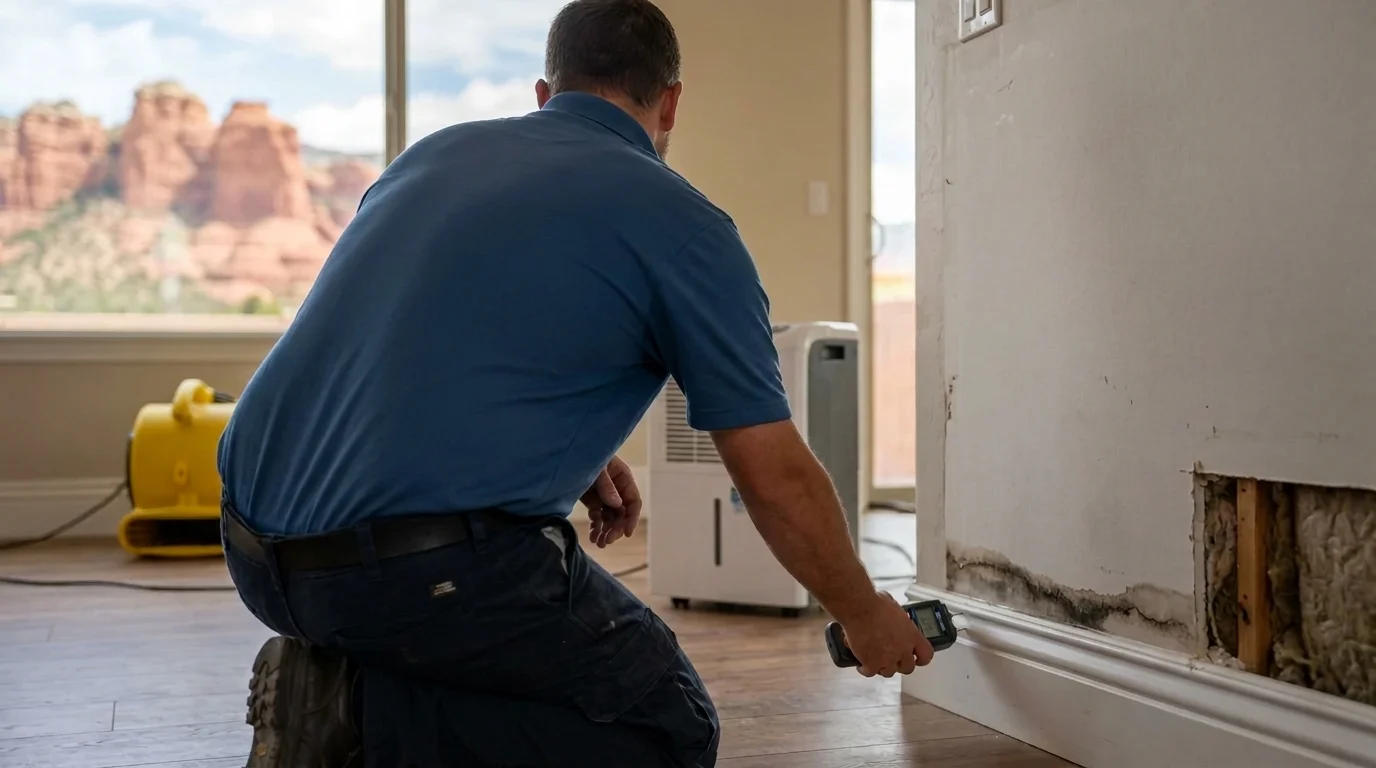
Documentation. The best water cleanup crews show up with moisture meters, write down readings room by room, and photograph the damage before and during the drying process. That paperwork is what your insurance adjuster uses to approve the claim. Our guide on what to do in the first 24 hours after water damage covers exactly what you should be seeing them do.
How much do IICRC certifications actually matter day to day?
IICRC certifications matter because they set the technical standard for how a structure should be dried, not just that it should be dried. The Institute of Inspection, Cleaning and Restoration Certification trains technicians to classify water by contamination level (Category 1 clean water, Category 2 gray water, Category 3 black water) and to size drying equipment based on actual psychrometric readings, not guesswork.
Without that training, it’s easy for a crew to pull equipment too early because the floor “feels” dry, while the wall cavity behind it is still holding moisture. That’s how a one-day water event turns into a mold remediation job three weeks later. Our post on how quickly mold grows after water damage walks through that timeline in more detail.
SDU’s technicians carry WRT, ASD, AMRT, and FSRT credentials, which means the same crew assessing your water damage is trained to recognize when a loss is moving toward a mold risk, before it becomes one.
What should you ask before you hire a water cleanup company?
Ask three questions before anyone starts extraction equipment in your home: are you IICRC certified, are you licensed and insured, and will you give me a written scope before work begins. A company that hesitates on any of these isn’t the one you want in your crawlspace.
A few more worth asking, especially in a market like Colorado Springs where hail, frozen pipes, and flash flooding below the Waldo Canyon burn scar all drive water calls:
- Do you work directly with my insurance adjuster, or will I be the go-between?
- What equipment will you leave running, and how will I know when the structure is actually dry?
- Are you locally based, or dispatched from out of town?
Our full breakdown on choosing a restoration company in Colorado Springs covers red flags to watch for, including the door-to-door storm chasers that show up after every hailstorm.
What should you do next?
If water is actively spreading, your next move is a phone call, not more research. Shut off the water source if it’s safe to do so, then call SDU Catastrophe Response at (303) 656-9934 or a comparably certified, locally based crew to get extraction started.
| Company | IICRC Certified Firm | 24/7 Emergency | Licensed & Insured | Locally Owned |
|---|---|---|---|---|
| SDU | Yes | Yes | Yes | Yes |
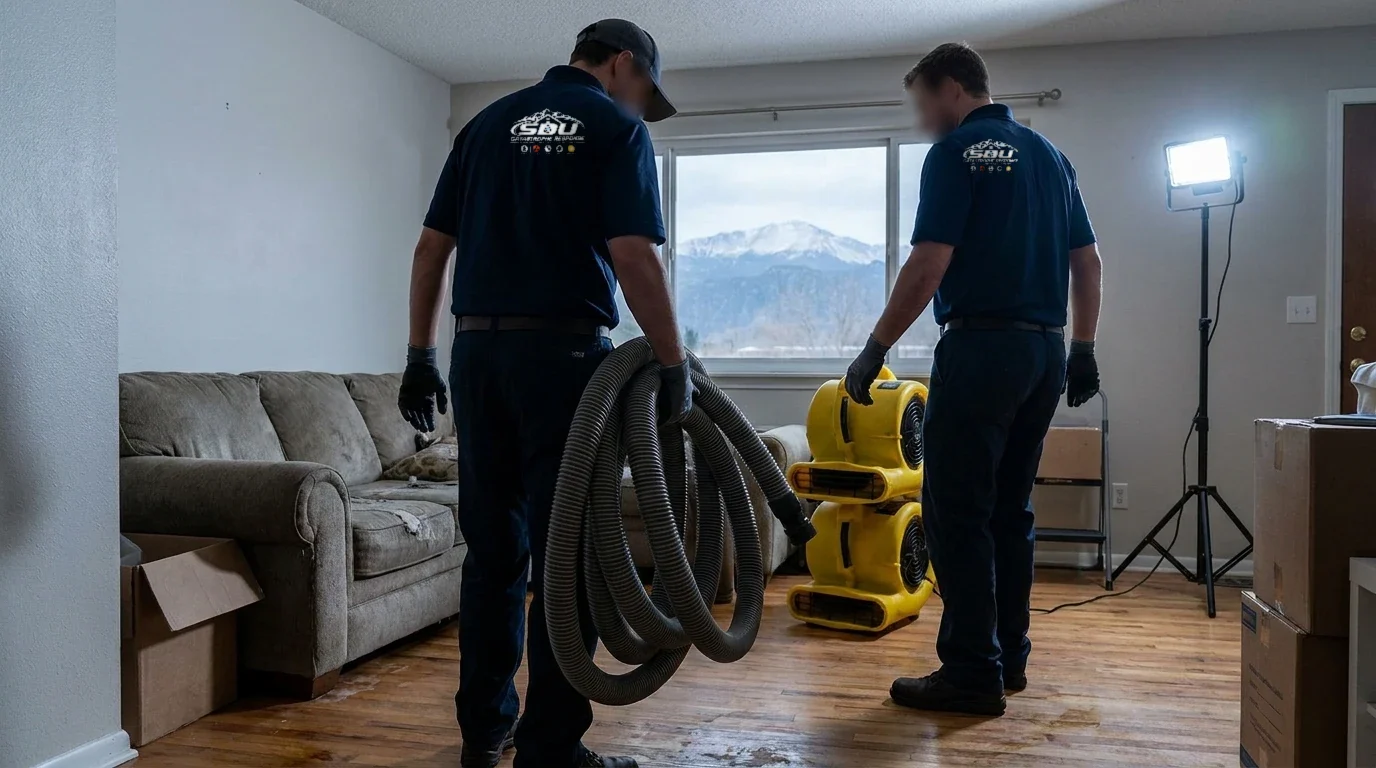
Water sitting on a subfloor for even 24 to 48 hours increases the odds of warping, delamination, and mold colonization. The sooner a certified crew gets air movers and dehumidifiers placed correctly, the less of your home gets torn out later.
About SDU Catastrophe Response
SDU Catastrophe Response is an IICRC Certified Firm based in Colorado Springs, CO, serving the Pikes Peak region including Monument, Fountain, Security-Widefield, Falcon, Black Forest, Manitou Springs, and Woodland Park. The company is licensed and insured, operates on a 24/7 emergency basis, and its crews hold IICRC credentials in water restoration, structural drying, mold remediation, and fire and smoke restoration. This post was written with the SDU team and author Spencer Udell.