24/7 Emergency Flood Damage Restoration in Colorado Springs
24/7 emergency flood damage restoration in Colorado Springs and surrounding areas. IICRC-certified, insurance billing accepted. Call (303) 656-9934.
Dealing with flood damage in Colorado Springs? Call (303) 656-9934 for emergency flood cleanup, available 24/7.
A burst supply line and a flood are not the same problem, and treating them the same way is how homes end up with hidden mold six weeks later. Floodwater that enters from outside, whether from a creek overflow, a flash flood off a burn-scarred hillside, or a storm surge pushing water under a slab, almost always carries silt, bacteria, and debris. That changes what has to be removed, how it’s handled, and how fast the clock is running before contamination sets into framing and subfloor.
What Flood Damage Restoration actually involves
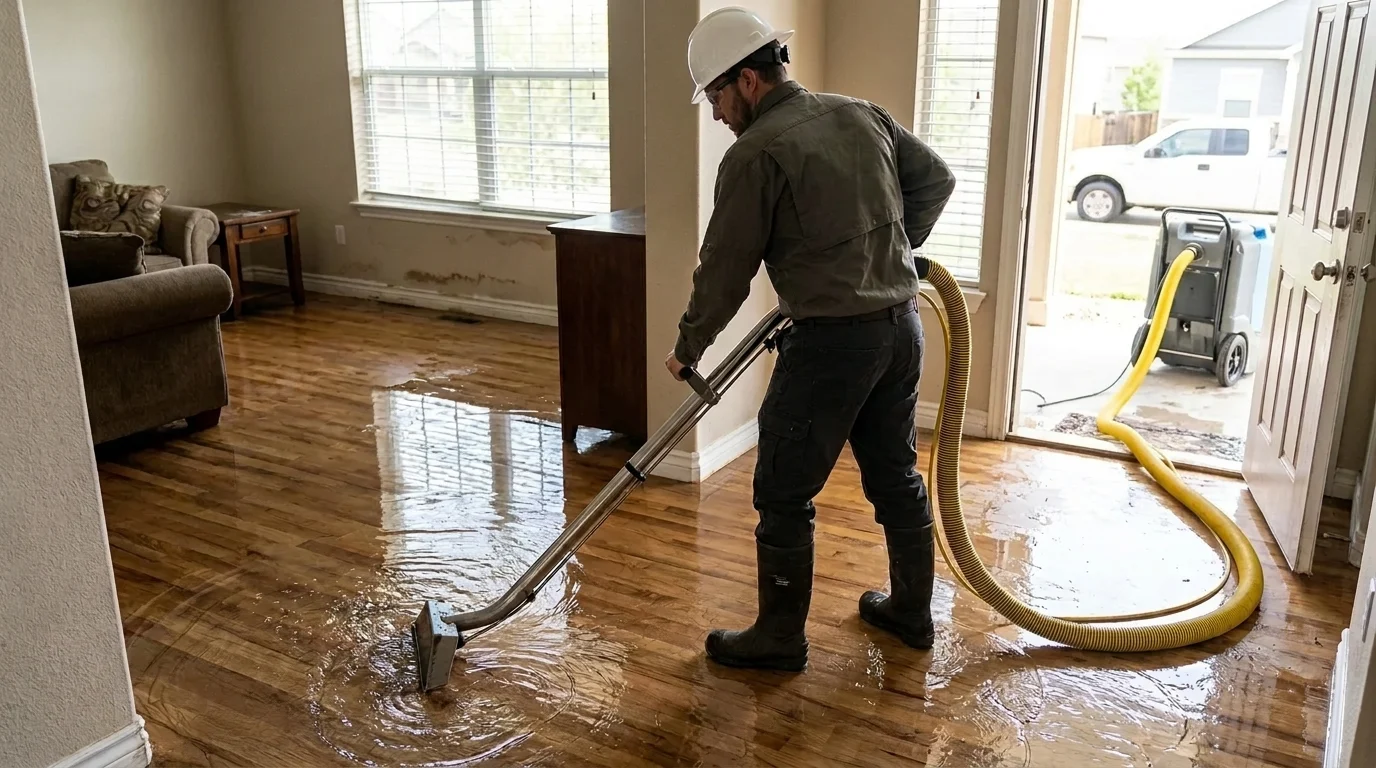
Flood restoration starts with the assumption that the water is contaminated until proven otherwise. Unlike a clean supply-line break, floodwater is classified as Category 3 by default, meaning porous materials it touches, carpet pad, drywall below the waterline, insulation, baseboard, generally can’t be dried in place and have to come out. Crews use submersible and truck-mounted pumps for standing water, then move to extraction wands for carpet and hard flooring. Once bulk water is gone, the real work is structural drying: industrial air movers and desiccant dehumidifiers run for days, not hours, with moisture readings logged in wall cavities, subfloor, and framing until numbers return to a dry standard, not just a dry feel. Basements, crawlspaces, and garage slabs are the most common trouble spots because water finds the lowest point and sits there long after the surface looks fine.
Our process
- Contamination categorization. Before anything else, the source and category of the water is documented, since this determines what gets dried versus removed, and it’s the first thing an adjuster will ask about.
- Extraction. Standing water is pumped and vacuumed out, prioritizing rooms where water is actively wicking into drywall or cabinetry.
- Controlled demolition. Saturated drywall, insulation, and flooring that can’t be safely dried are removed to a measured height, usually cut above the visible waterline to catch wicking.
- Structural drying and monitoring. Air movers, dehumidifiers, and moisture meters stay in place with daily or near-daily readings until framing, subfloor, and remaining materials hit a verified dry standard under IICRC S500 guidelines.
- Antimicrobial treatment and clearance. Exposed structural surfaces are treated to address bacteria and contaminants from the floodwater before rebuild work begins.
What separates a good flood response from a bad one
The most common mistake is under-removal: cutting drywall too low, leaving wet insulation behind a vapor barrier, or trying to dry carpet pad that’s been sitting in contaminated water for more than 24 to 48 hours. It looks dry at the surface while the material underneath stays saturated and starts breaking down. Adjusters are trained to look for moisture-mapping documentation, photos at each stage, and a clear equipment log, so a response that skips documentation often gets challenged or underpaid during the claim. A careful operator also checks areas that aren’t obviously wet, like the top plate of a basement wall or under cabinet toe-kicks, because flood water migrates further than it appears to from the surface.
What does Flood Damage Restoration cost?
Every flood loss behaves differently depending on how much water entered, how long it sat, and how much demolition is required, so SDU Catastrophe Response provides a written scope of work before any restoration begins. Homeowners insurance typically does not cover damage from rising floodwater unless a separate flood policy is in place, though wind-driven rain intrusion or water from a covered peril may be handled differently, so it’s worth confirming coverage details with your carrier early. Below are typical industry ranges, not quotes, since actual cost depends on the scope documented on-site.
| Scenario | Typical range |
|---|---|
| Single room, shallow floodwater, quick response | $1,500 - $4,000 |
| Finished basement, 1-2 feet of water | $6,000 - $15,000 |
| Whole-level flood with drywall and flooring removal | $12,000 - $30,000 |
| Flood with extended dwell time and mold growth | $20,000 - $45,000+ |
| Crawlspace flood with insulation and subfloor damage | $4,000 - $10,000 |
Seasonal & regional considerations
Colorado Springs sees two distinct flood risk windows: spring snowmelt runoff that can overwhelm drainage along Fountain Creek and Monument Creek, and summer monsoon season, when fast-moving thunderstorms drop heavy rain in short bursts. Burn-scarred terrain upstream of some neighborhoods sheds water faster than vegetated slopes, which can turn a normal summer storm into a flash flood with little warning. The region’s clay-heavy soils also drain slowly, so standing water around foundations and in window wells can linger longer than homeowners expect, adding to basement intrusion risk.
Service area
SDU Catastrophe Response handles flood damage restoration across Colorado Springs and the surrounding communities, including Monument, Fountain, Woodland Park, and Pueblo.
If floodwater has reached your home, every hour it sits raises the odds of contamination spreading into materials that can’t be saved. Call (303) 656-9934 to get a crew started on extraction and a documented drying plan today.
Frequently Asked Questions
Does homeowners insurance cover flood damage restoration?
Why does floodwater require removing materials that look fine?
How long does structural drying take after a flood?
What should I do with my belongings while floodwater is being removed?
Can flood-damaged basements be fully dried, or does flooring always need to be replaced?
Looking for the best flood damage restoration company in Colorado Springs?
SDU Catastrophe Response provides flood damage restoration in Colorado Springs, CO and the surrounding area. We answer calls 24/7 — call (303) 656-9934 for immediate help.
Need Flood Damage Restoration now?
We respond 24/7 across Colorado Springs and surrounding CO cities.