TL;DR: Flooded crawl space cleanup in Colorado Springs typically costs $500 to $8,000 or more. The price depends on whether water is standing or the soil is just damp, how much insulation and vapor barrier has to come out, and whether mold has already started growing. Simple damp-soil jobs often land near $500 to $1,200. Standing water with soaked insulation and a full vapor barrier replacement usually runs $3,000 to $6,500. Get a written scope before anyone starts cutting into insulation or barrier material.
If you just crawled under your house with a flashlight after a week of Pikes Peak snowmelt and found an inch of water pooling against the foundation, you’re not alone. Front Range homes in neighborhoods like Old Colorado City and Broadmoor see this every spring thaw and again after summer downpours, because frost-heaved soil and clay-heavy ground push water toward the lowest point under the house. What you do in the next 24 to 48 hours determines whether this stays a cleanup job or turns into a mold remediation job.
How much does flooded crawl space cleanup cost in Colorado Springs?
Most flooded crawl space jobs in the Colorado Springs area run between $500 and $8,000, with the majority falling in the $1,500 to $5,500 range. The biggest swing factor is whether water is actively standing versus the soil just being saturated, followed by how much insulation and vapor barrier material has to be torn out and replaced.
| Scenario | Typical Cost Range |
|---|---|
| Damp soil, no standing water, small crawl space (under 500 sq ft) | $500 - $1,200 |
| Standing water, 1-2 inches, extraction and structural drying | $1,500 - $3,500 |
| Standing water with soaked batt insulation removal | $2,500 - $5,500 |
| Flooded crawl space with full vapor barrier replacement | $3,000 - $6,500 |
| Visible mold growth requiring remediation | $4,000 - $8,000+ |
| Large crawl space (over 1,500 sq ft) or tight-clearance access | add 20-40% to the ranges above |
Every crawl space is different, and a reliable number only comes after someone has actually been under the house with a moisture meter. Any company should hand you a written scope before work starts, not a phone estimate.
What drives the price up or down?
The biggest cost factors are how contaminated the water is, how much material has to come out, and how hard the space is to work in. A clean-water leak that’s caught fast costs far less than groundwater that’s been sitting for a week.
- Standing water vs. damp soil. Pumping and extracting standing water adds equipment time that a damp-soil job doesn’t need.
- Category of water. A burst supply line is usually Category 1 (clean) water. Groundwater that seeped in under hydrostatic pressure from frost heave or a wet spring is Category 2 (gray water) per the ANSI/IICRC S500 standard, and any backup from a sewer line is Category 3, which costs more to handle safely.
- Insulation condition. Soaked fiberglass batt insulation almost always has to be cut out and bagged, not dried in place.
- Vapor barrier damage. A torn or waterlogged poly vapor barrier gets replaced as part of cleanup. Full crawl space encapsulation (sealed, insulated liner systems) is a separate specialty job handled by a different contractor, not part of standard flood cleanup pricing.
- Access. Low clearance, a single small hatch, or a crawl space under an addition all slow the work down and add labor hours.
- Square footage. A 2,000 sq ft crawl space under a Briargate two-story takes longer to dry than a 400 sq ft space under a Manitou Springs cottage.
Will homeowners insurance cover it?
Coverage depends entirely on what caused the water, not on the fact that it’s a crawl space. A sudden, accidental source like a burst supply line is usually covered under a standard policy. Groundwater seeping in from melting snow or heavy rain is generally treated as flood damage and excluded unless you carry a separate flood policy.
Most homeowners policies pay for sudden and accidental water damage from inside the home, such as a pipe that splits or a water heater that fails outright. They typically exclude gradual seepage, long-term moisture, and flood, meaning rising groundwater or surface water working its way under the foundation, according to the Insurance Information Institute. That groundwater intrusion through the foundation during spring thaw is the scenario that catches a lot of Colorado Springs homeowners off guard, because it feels like “just water under the house” but is handled like a flood claim.
Document everything with photos before cleanup starts, note the source of the water if you know it, and call your agent to ask directly whether your policy has a water backup or flood endorsement. Our guide to homeowners insurance and water damage walks through how adjusters typically classify these claims.
What does the cleanup process involve?
Crawl space cleanup follows the same drying science as any other water loss, just in a tighter space with less airflow to start. The process has five steps: assess, extract, remove damaged material, dry, and verify.
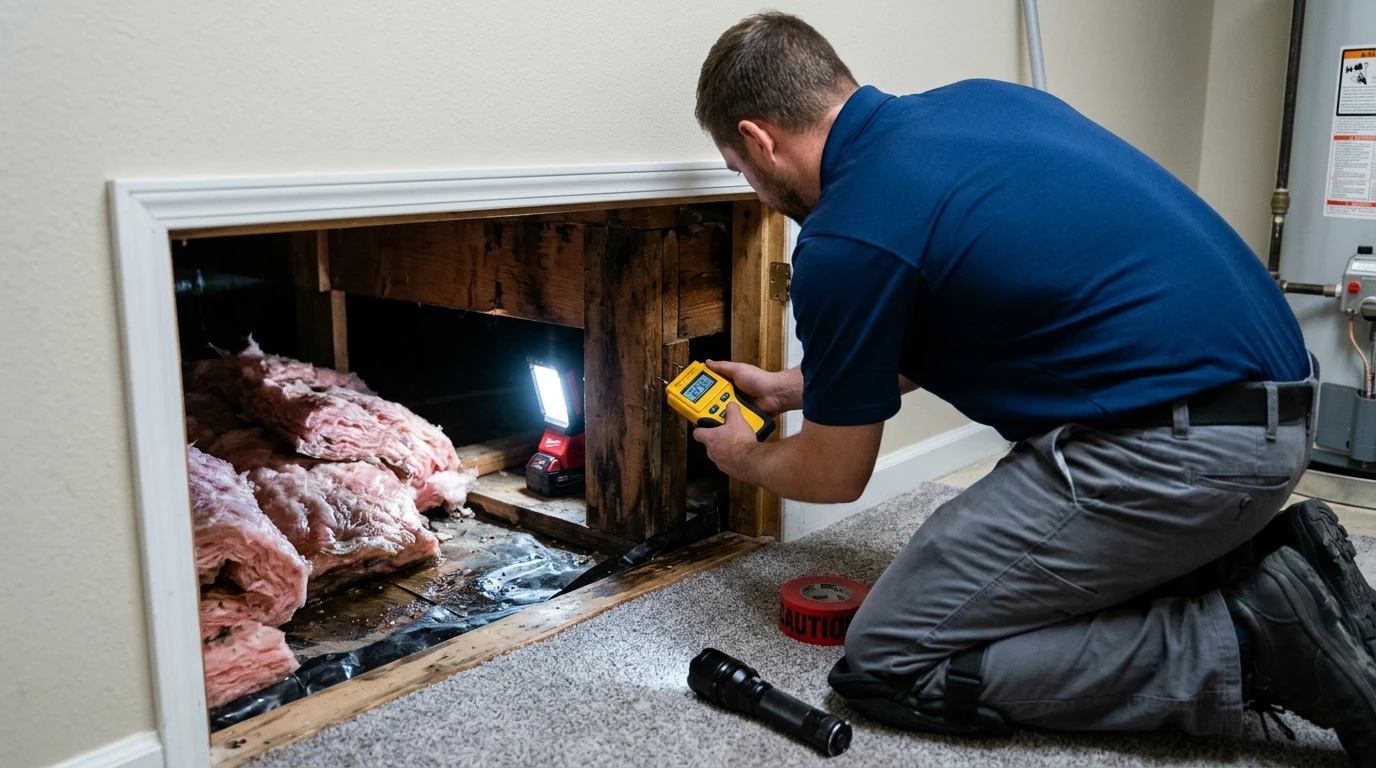
- Assessment. A technician identifies the water source, categorizes the water, and checks moisture levels in the subfloor, joists, and insulation with a penetrating moisture meter.
- Extraction. Standing water gets pumped or wet-vacuumed out before drying equipment goes in.
- Material removal. Saturated insulation and damaged vapor barrier are cut out and bagged for disposal; sound structural wood stays in place for drying.
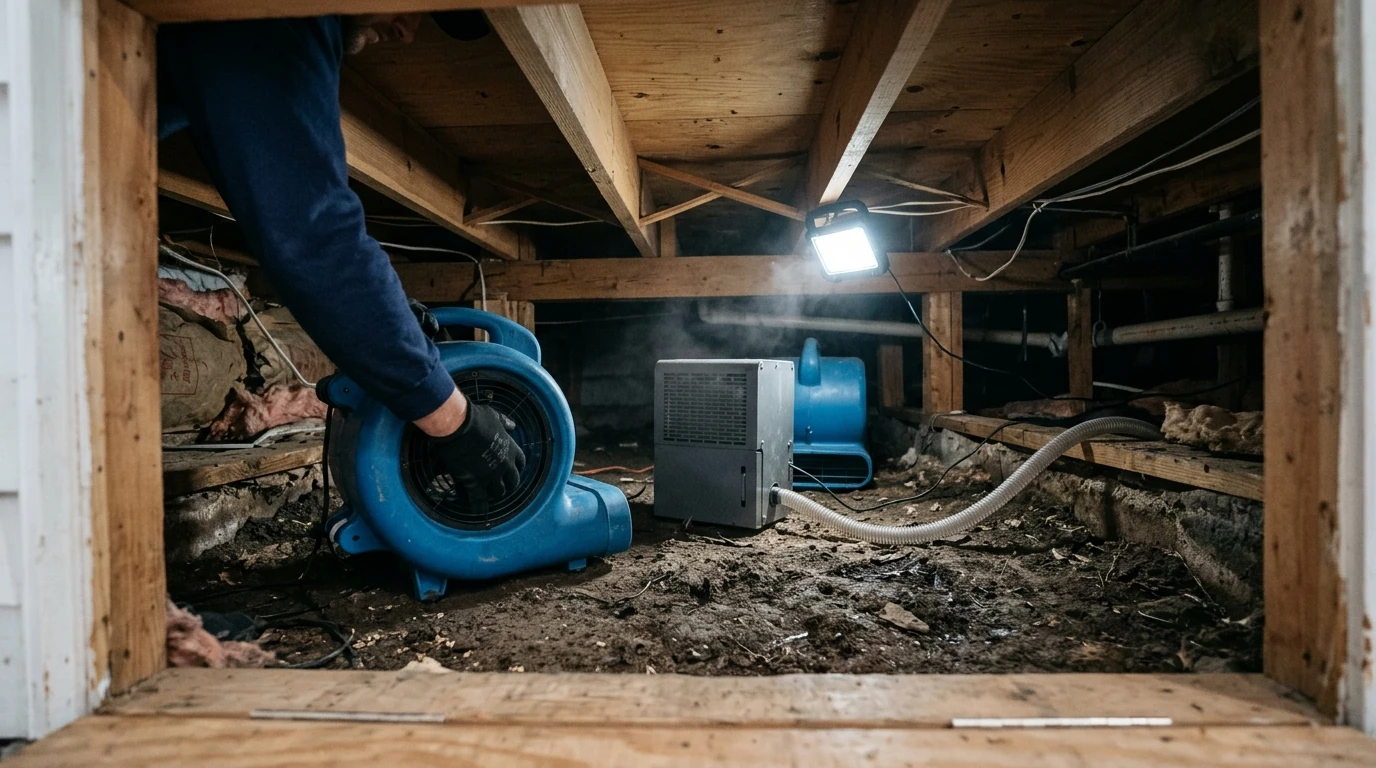
- Structural drying. Air movers and a dehumidifier run in the crawl space, often for 3 to 7 days, with daily moisture readings to confirm the wood is drying, not just the air.
- Verification and rebuild. Once moisture readings return to normal, new vapor barrier goes down and insulation gets replaced where needed.
A wet crawl space that sits untreated is also how mold starts. Mold can begin growing on damp wood and insulation within 24 to 48 hours, per the EPA, so the gap between discovering standing water and starting extraction matters more than people expect. If you’re unsure how far along that clock already is, our post on how quickly mold grows after water damage breaks down the timeline.
Can you clean a flooded crawl space yourself?
A damp-soil crawl space with no standing water and a quick-drying fan setup is sometimes manageable as a DIY job. Standing water, low-clearance spaces, soaked insulation, or any sign of mold is where it stops being a weekend project and starts being a job for equipment most homeowners don’t own.
The risk isn’t just the labor. It’s drying the wrong way, too slowly, or not far enough, and finding out six weeks later that mold has colonized the joists. If there’s standing water, a sewer smell, or the crawl space has been wet for more than a day or two, it’s worth getting a moisture assessment from a crew that works under houses for a living. SDU Catastrophe Response is an IICRC Certified Firm that handles water extraction and structural drying for crawl spaces across Colorado Springs, Monument, and Fountain, and can tell you within the first visit whether you’re looking at a cleanup job or a mold remediation job.
A flooded crawl space rarely stays a small problem if it’s ignored. Request a moisture assessment before the next freeze-thaw cycle pushes more water under the house, and get a written scope so you know exactly what you’re paying for before anyone starts cutting into insulation.
About SDU Catastrophe Response
The company is an IICRC Certified Firm serving Colorado Springs, CO and the surrounding Front Range, with technicians holding IICRC WRT, ASD, and AMRT credentials for water extraction, structural drying, and mold remediation. It operates on a 24/7 basis and handles water cleanup, emergency water removal, mold remediation, and storm damage restoration for homes and businesses in El Paso and Teller counties.
Need help now? Call SDU Catastrophe Response at (303) 656-9934.