Industrial Restoration in Colorado Springs
24/7 industrial restoration in Colorado Springs and surrounding areas. IICRC-certified, insurance billing accepted. Call (303) 656-9934.
A chiller line fails over a holiday weekend inside a 40,000-square-foot distribution center, and by Monday morning three feet of standing water have soaked into pallet racking, conveyor motors, and a slab that was never sealed for this. Industrial losses don’t behave like residential ones. The volume is bigger, the equipment is more expensive to replace, and every day a plant sits offline costs more than the damage itself. SDU Catastrophe Response handles industrial water damage, industrial fire damage, and large-scale structural drying for warehouses, manufacturing plants, and processing facilities across the Colorado Springs area, with crews and equipment sized for the square footage.
What Industrial Restoration actually involves
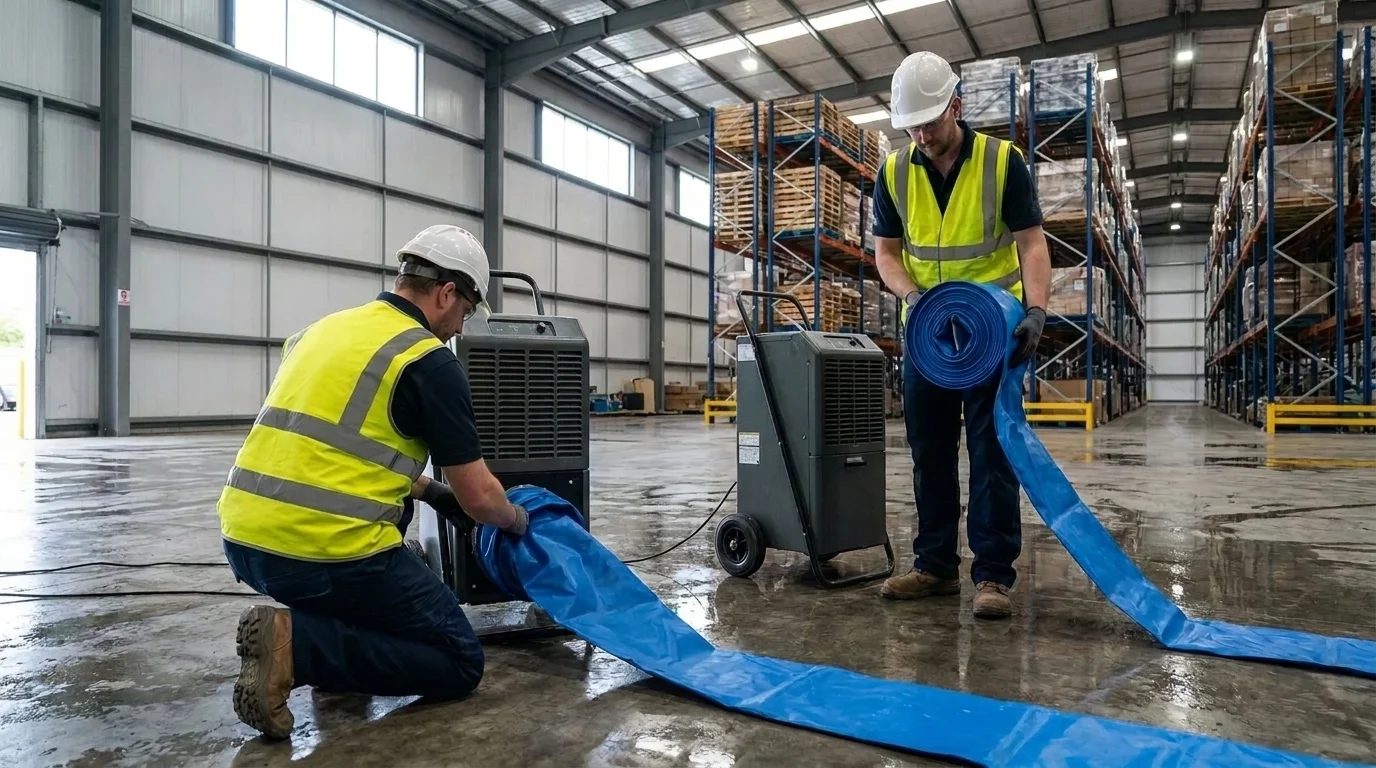
Industrial restoration covers the same core damage types as commercial work, water, fire, smoke, and storm, but at a scale that changes the equipment and the math. A warehouse flood isn’t three air movers and a dehumidifier; it’s a fleet of low-grain refrigerant dehumidifiers running against open-bay ceiling heights, truck-mount extraction for standing water across concrete and epoxy-coated slabs, and moisture mapping across racking, machine bases, and floor penetrations that a residential moisture meter was never built to read. Industrial fire damage adds soot characterization for synthetic materials common in manufacturing (plastics, coatings, insulation) that burn and off-gas differently than a house fire, plus equipment decontamination so motors and control panels aren’t corroded by residue sitting on contacts. Timelines run longer than residential jobs, often one to three weeks for full structural drying and equipment assessment on a mid-size facility, because the goal isn’t just dry, it’s dry enough to restart production safely.
Our process
- Facility assessment and shutdown coordination. Before anything gets wet-vacced or fogged, we walk the affected zones with facility management to identify which systems need to be powered down, isolated, or tagged out before crews move in.
- Bulk water extraction and debris staging. High-volume extraction equipment clears standing water across open floor plans while damaged stock, pallets, or finished goods get staged separately for the insurance adjuster’s documentation.
- Zone-based structural drying. Large open spaces dry unevenly, racking shadows airflow and HVAC returns pull moisture in directions a single-room drying plan never accounts for, so we set drying zones and monitor each one with daily moisture readings instead of one blanket reading for the whole building.
- Equipment and MEP decontamination. Motors, control panels, conveyor systems, and exposed wiring get inspected and cleaned separately from the structure, since corrosion and residue on electrical components can fail weeks after the structure reads dry.
- Documentation and restart clearance. We provide moisture logs and drying documentation facility managers can hand to insurance and, where relevant, to their own engineers before equipment goes back online.
What separates a good industrial restoration response from a bad one
The most common mistake on industrial losses is treating the building like one big residential room: a handful of dehumidifiers dropped in the middle of the floor and a hope that airflow finds its way into racking aisles and mezzanine spaces. It doesn’t. Good operators set drying zones based on the actual floor plan and airflow obstructions, and they document moisture readings by zone, not as a single building-wide average. Insurance adjusters on industrial claims are also looking for something residential adjusters rarely ask about: business interruption documentation. A clear record of what was shut down, when drying started, and when each zone cleared matters for the downtime portion of the claim, not just the property damage portion. Skipping that documentation step is one of the more expensive mistakes a facility manager can make without realizing it until the claim gets contested.
What does Industrial Restoration cost?
Industrial losses vary more than almost any other restoration category, since a single-tenant warehouse flood and a multi-line manufacturing fire have almost nothing in common cost-wise. The ranges below reflect typical industry figures for industrial-scale jobs, not a quote, and every facility gets a written scope before work begins so there are no surprises once drying equipment is on site.
| Scenario | Typical range |
|---|---|
| Partial warehouse flood, clean water, under 10,000 sq ft | $8,000 - $25,000 |
| Full-facility water extraction and drying, 10,000-50,000 sq ft | $30,000 - $120,000 |
| Industrial fire, contained to one production line | $50,000 - $200,000+ |
| Smoke and soot remediation across open-bay manufacturing space | $20,000 - $80,000 |
| Equipment and MEP decontamination (added to above) | $5,000 - $40,000 |
Most commercial property policies cover sudden water and fire losses to the structure and, depending on the policy, business interruption, but coverage for stock, inventory, and specialized equipment varies widely by policy and should be confirmed with the facility’s broker or adjuster before assuming full replacement.
Seasonal & regional considerations
Colorado Springs winters bring hard freeze-thaw cycles that stress exposed plumbing, sprinkler lines, and loading dock seals in industrial buildings the same way they stress residential pipes, just with more linear feet of pipe at risk. Facilities with unheated warehouse sections or older sprinkler systems see more freeze-related line failures between December and February. Summer hailstorms along the Front Range are the other recurring driver, roof membrane damage on large flat industrial roofs can go unnoticed for weeks until a storm drives water through it.
Service area
SDU Catastrophe Response serves industrial and manufacturing facilities throughout Colorado Springs and the surrounding Front Range, including Fountain, Monument, Woodland Park, and Pueblo.
If your facility is dealing with standing water, fire damage, or smoke contamination across production or warehouse space, call (303) 656-9934 to get a crew and a written scope moving before downtime costs more than the damage already has.
Frequently Asked Questions
Does insurance cover industrial water or fire damage?
How long does drying take in a large warehouse or plant compared to a house?
Can production equipment be restarted before the building is fully dry?
What's different about soot cleanup in a manufacturing facility versus a house fire?
Do you provide documentation for business interruption claims?
Looking for the best industrial restoration company in Colorado Springs?
SDU Catastrophe Response provides industrial restoration in Colorado Springs, CO and the surrounding area. We answer calls 24/7 — call (303) 656-9934 for immediate help.
Need Industrial Restoration now?
We respond 24/7 across Colorado Springs and surrounding CO cities.